What Is RFID?
Radio Frequency Identification (RFID) is a wireless technology that uses radio waves to automatically identify and track objects, animals, or people. Unlike a barcode that must be physically scanned line-by-sight, an RFID tag can be read from a distance, through packaging, and even through walls all without any human intervention.
Think of it this way: a barcode is like a photograph. An RFID tag is like a two-way radio. One just reflects information, the other actively communicates it.
Expert Insight “RFID has crossed a critical threshold in the past two years. UHF inlay prices dropping below $0.04 per tag combined with Gen2v3 protocol improvements have removed the two biggest barriers to mass adoption: cost and read reliability in crowded environments.”
Every RFID system regardless of scale relies on three core components working together:
- An RFID Tag (transponder) attached to the object being tracked
- An RFID Reader (interrogator) that sends out radio signals
- An Antenna that focuses and receives those radio waves
- Software/Middleware that processes and acts on the collected data
When the reader broadcasts a signal, any tag in range responds with its stored data. That data flows into your software ERP, WMS, inventory system and becomes actionable intelligence. The whole process takes milliseconds
How RFID Works: Step-by-Step
Understanding the signal flow is essential before choosing or deploying a system.
| POWER UP — The reader broadcasts an electromagnetic field through its antenna. Passive tags harvest energy from this field, active tags use their own battery. |
| RESPOND — The tag’s chip activates and modulates the incoming signal to encode its stored data (EPC, serial number, sensor readings, etc.). |
| RECEIVE — The reader’s antenna captures the reflected/emitted signal and hands it to the reader’s onboard processor. |
| DECODE — The reader filters, deduplicates, and decodes the raw signal into structured data. |
| ACT — Data is pushed via API or middleware to your ERP, WMS, or analytics platform where business logic triggers the right workflow. |
The 3 Core RFID Hardware Components
1. RFID Tags (Transponders)
The tag is the digital identity of your physical object. Every tag contains at minimum a microchip ) and an antenna. What separates tags is their power source and that single difference defines range, cost, and application suitability.
| Feature | Passive | Semi-Passive | Active |
| Power Source | Reader’s RF field | Internal battery (chip only) | Internal battery (full) |
| Read Range | Up to 12m (UHF) | Up to 30m | Up to 150m+ |
| Tag Cost | $0.04 – $0.50 | $1 – $5 | $15 – $75 |
| Battery Life | No battery | 2 – 7 years | 1 – 5 years |
| Best For | Retail, logistics, library | Cold chain, pharma | RTLS, heavy industry |
| 2025 Market Share | ~87% of all tags | ~5% | ~8% |
2. RFID Readers (Interrogators)
The reader is the system’s intelligence hub. It broadcasts the electromagnetic field, manages the anti-collision protocol, processes signals, and forwards clean data to your software stack.
Reader form factors in 2026:
- Fixed readers — Portal/gate-mounted; ideal for dock doors, assembly lines, retail entrances
- Handheld readers — Mobile scanning for inventory audits, receiving, picking confirmation
- Ceiling-mounted readers — A 2025 innovation reducing floor congestion in retail
- Forklift-mounted readers — Automated inventory capture during normal warehouse operations
- Drone-mounted readers — Emerging for high-rack warehouse inventory in 2025–2026
3. RFID Antennas
Antennas are what most RFID deployments get wrong. The antenna determines your read zone its shape, gain, and polarization control where and how tags are detected. Two critical specifications:
- Polarization: Linear antennas offer longer range but require tags to be oriented correctly. Circular antennas (LHCP/RHCP) are orientation-agnostic and far more practical for real-world environments.
- Gain (dBi): Higher gain = narrower but longer beam. Lower gain = wider coverage area at shorter range.
Impinj expanded its Gen2X RAIN RFID protocol (November 2025), enabling faster inventory reads, improved reader sensitivity, stronger counterfeit protection, and enhanced privacy features for large-scale enterprise deployments. This is now the reference standard for new UHF deployments.
RFID Frequency Bands: LF, HF, UHF, and Microwave
Frequency is not just a technical spec it determines whether your system will work in your specific environment with your specific materials. Choosing the wrong frequency is the single most common RFID project failure.
| Band | Frequency | Read Range | Metal/Liquid | Data Speed | Typical Use |
| LF | 125–134 kHz | < 0.5m | Excellent | Slow | Animal ID, access control, automotive immobilizers |
| HF / NFC | 13.56 MHz | < 1m | Good | Moderate | Smart cards, payments, passports, library books |
| UHF | 860–960 MHz | 1–12m | Poor (needs on-metal tags) | Fast | Retail, logistics, warehousing, supply chain |
| Microwave | 2.45 / 5.8 GHz | < 1m (high-speed) | Good | Very Fast | Toll systems, industrial automation, vehicle ID |
UHF RFID and the RAIN Alliance Standard
UHF RFID operates under the GS1 EPC Gen 2 (ISO 18000-63) standard the global interoperability framework for supply chain RFID. In 2025, GS1 finalized the Gen2v3 update, bringing critical improvements for dense reader environments, enhanced tag privacy controls, and improved anti counterfeiting capabilities.
Regional frequency allocations matter for importers and multinationals:
- Europe (ETSI): 865–868 MHz, max 2W ERP
- USA (FCC): 902–928 MHz, max 4W EIRP
- Turkey (BTK/KET): 865–868 MHz (ETSI-aligned)
- China (MIIT): 920–925 MHz
RFID vs. Barcode: When to Choose Which
Barcodes aren’t dead but they’re limited. Here’s an honest, side-by-side comparison for decision makers:
| Criterion | Barcode | RFID |
| Line of sight required? | Yes — must be physically visible | No — reads through packaging, boxes, pallets |
| Items per scan | 1 at a time | Up to 1,000 per second (UHF) |
| Data writable? | No — fixed at print | Yes — rewritable (read/write tags) |
| Data capacity | ~100 characters (QR), 20 (linear) | Up to 96,000 bits (EPC + user memory) |
| Environmental durability | Low — fades, tears, smears | High — withstands heat, moisture, chemicals |
| Tag/label cost | < $0.01 | $0.04 – $75 (type dependent) |
| Setup cost | Very low | Moderate to high (infrastructure) |
| Best for | Low-volume, simple tracking, POS | High-volume, automated tracking, supply chain |
Bottom Line for Decision-Makers: If you scan fewer than 500 items per day and each scan is done manually by a person in a clean environment — a barcode system is perfectly fine. Once you need automation, high speed, bulk reads, or tracking in challenging environments, RFID delivers ROI that barcodes cannot match.
Where RFID is Used: Industry Applications in 2025- 2026
Retail & Apparel
Retail accounts for nearly 35% of global RFID adoption in 2025. IDTechEx estimates that retail apparel alone required over 31 billion RFID tags in 2025 though RFID still covers only about 40% of the total addressable apparel market, signaling substantial room for growth.
- Inventory accuracy improved from industry average of 65% (barcode) to 99%+ with RFID item-level tagging
- Reduction in out-of-stock events by 50–80% in omnichannel deployments
- RFID-enabled self-checkout reducing queue times and shrinkage simultaneously
- Walmart mandate expanded to meat, bakery, deli Avery Dennison now producing sensor enabled, high-moisture labels for perishables

Warehouse & Logistics
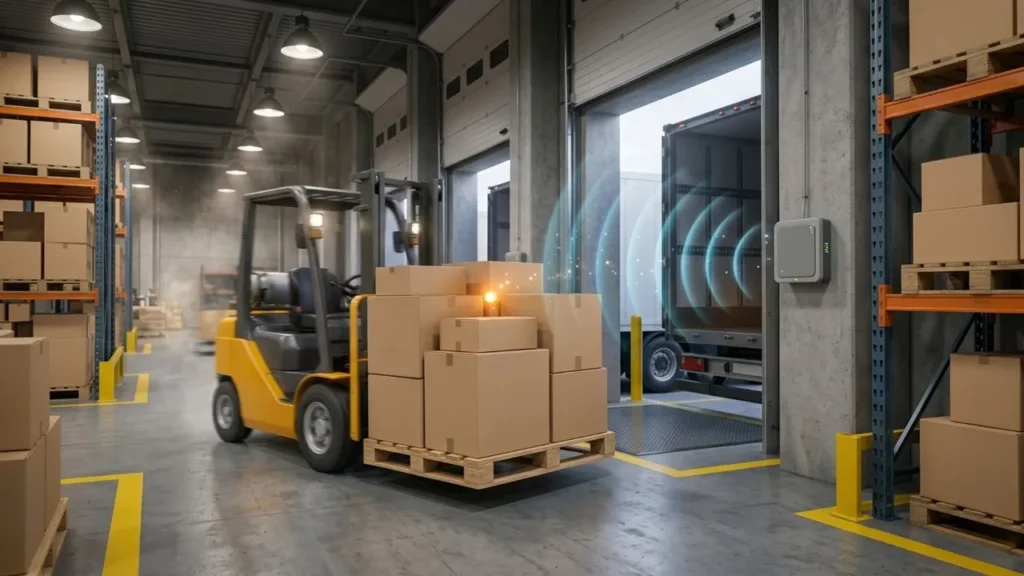
- Dock door readers automatically log every pallet entering or leaving eliminating manual receiving errors
- Forklift mounted readers create continuous inventory snapshots during normal operations
- Cross docking accuracy rates above 99.5% in RFID enabled facilities
- Zebra Technologies’ AI-powered RFID suite enables predictive restocking and anomaly detection
Healthcare & Pharmaceuticals
Healthcare is the fastest-growing RFID segment at 13.7% CAGR (Roots Analysis, 2025). According to the ASHP Foundation, approximately 40% of US healthcare facilities have deployed RFID, reporting a 72% decrease in expired drugs and 82% improvement in inventory tracking.
- Patient wristband tracking real-time location in hospital, allergy alerts, medication verification
- FDA DSCSA compliance full pharmaceutical serialization from manufacturer to dispenser
- Surgical instrument tracking ensuring sterilization compliance and preventing retention incidents
- Blood bag and sample tracking reducing transfusion errors

Manufacturing & Industry 4.0
- Work-in-progress tracking every component tagged, every step of the assembly line timestamped
- Tool and jig management knowing exactly where every critical tool is at any moment
- Quality control gates RFID readers at inspection points confirm correct parts, correct sequence
- Automotive BMW, Mercedes, Toyota all use RFID for door to door component tracking from supplier to assembly line
Other Key Sectors
- Libraries: Automated checkout, overnight inventory, anti theft EAS replacing barcodes globally
- Aviation: RFID baggage tracking mandated by IATA Resolution 753 Dubai, Qatar Airways leading in MENA
- Cold Chain: Semi passive temperature sensing tags monitoring pharmaceutical and food shipments
- Agriculture: 930 million LF tags used for livestock tracking in 2025 (IDTechEx) required by law in the EU, Australia, and growing regions
- Data Centers: RFID tracking of every server, cable, and rack Powercast won the 2025 RFID Journal Award for Best New Product for battery-free RAIN RFID sensor tags for data centers
RFID Technology Trends for 2026
AI + RFID = Predictive Operations
The biggest shift in RFID is not in the hardware it’s what happens to the data after the read. AI and machine learning platforms are turning millions of raw tag events into predictions: which shelf will be empty in 4 hours, which asset is about to fail, which shipment will be delayed.
Sustainable & Recyclable RFID Labels
The pressure to reduce e-waste and improve recyclability is changing tag design fundamentally. In August 2025, Beontag showcased its ECO Line of recyclable, paper based RFID tags at LabelExpo Europe paper substrate, recyclable adhesive, no PET film.
- Avery Dennison’s AD Pure series — 100% PET plastic RFID inlays for easier recycling streams
- Chipless RFID tags (printed electronics, no silicon) are emerging for ultra low cost, compostable applications
- EU Digital Product Passport legislation is accelerating demand for durable, traceable, eco-compatible tags
Gen2v3 Protocol
GS1’s Gen2v3 is the protocol upgrade that makes RFID reliable in the places it used to struggle: dense tag environments, mixed-material loads, and high interference industrial settings. Impinj’s November 2025 Gen2X expansion of RAIN RFID brought faster reads, stronger counterfeit protection, and enhanced privacy positioning this as the required specification for any new large scale deployment in 2026.
5G-Enabled RFID Infrastructure
5G connectivity is enabling a new class of RFID deployments: large outdoor facilities (ports, airports, construction sites) where Wi-Fi infrastructure is impractical. 5G backhaul allows RFID readers to push data from any location instantly, enabling autonomous solutions like self-driving forklifts that navigate using RFID + 5G positioning.
RFID ROI: What Are the Real Numbers?
The business case for RFID is well documented across industries. These are not vendor marketing claims they come from independent operational studies and published case data
| Industry | Key Metric | Before RFID | After RFID |
| Retail (Apparel) | Inventory accuracy | 65% | 99%+ |
| Pharma (US) | Expired drug waste | Baseline | 72% reduction (ASHP, 2022) |
| Pharma (US) | Inventory tracking accuracy | Baseline | 82% improvement (ASHP, 2022) |
| General Warehouse | Physical inventory time | 2 days (5,000 SKUs) | 90 minutes |
| Retail (Multi-store) | Out-of-stock events | Baseline | 50–80% reduction |
| Manufacturing | Work-in-progress accuracy | ~85% | >99% |
A distribution center managing 5,000 SKUs previously needed an entire team and two full days to complete a physical inventory count. After deploying fixed UHF RFID readers at dock doors and handheld readers for cycle counts, the same count now takes 90 minutes with higher accuracy. The ROI on the hardware investment was achieved in less than 8 months.
Typical RFID Project Cost Structure
| Cost Category | Small Deployment | Enterprise Scale |
| UHF Tags (per unit) | $0.04 – $0.15 | $0.04 – $0.08 (volume) |
| Fixed Readers (each) | $1,500 – $3,500 | $800 – $2,000 (volume) |
| Antennas (each) | $100 – $400 | $80 – $250 (volume) |
| Handheld Readers | $1,000 – $3,500 | $800 – $2,500 |
| Middleware / Software | $500 – $5,000/yr | $10,000 – $100,000+/yr |
| Installation & Integration | $5,000 – $20,000 | $50,000 – $500,000+ |
Frequently Asked Questions About RFID (FAQ)
What is RFID and how does it work?
RFID is a wireless technology that uses radio waves to automatically identify and track objects. A reader broadcasts an electromagnetic field; tags attached to objects harvest energy from this field or use their own battery, then transmit their stored data a unique ID code back to the reader. The data is captured in milliseconds without any line of sight or human interaction, and flows directly into inventory, ERP, or tracking software.
What is the difference between RFID and NFC?
NFC (Near Field Communication) is a subset of HF RFID that operates at 13.56 MHz with a maximum read range of about 4cm. Both use the same frequency band, but NFC is designed for short-range, secure, consumer-facing applications contactless payments, phone pairing, smart posters. Standard RFID (especially UHF) is designed for longer ranges, bulk reads, and supply chain automation. Think of NFC as the ‘tap to pay’ cousin of the broader RFID family.
How much does an RFID system cost?
Costs vary significantly by scale and environment. A basic pilot setup (1–2 fixed readers, antennas, and tags for a single dock door) can start around $5,000–$15,000 including installation. Enterprise deployments across multiple sites range from $100,000 to several million. UHF passive tags now cost as little as $0.04 each at volume. The most significant cost is typically system integration with existing ERP/WMS software, not the hardware itself.
Can RFID work on metal or near liquids?
Standard UHF RFID tags perform poorly on metal surfaces and near liquids, as both detune the antenna and absorb radio waves. Solutions exist: on-metal (also called ‘hard tags’) use a foam or ferrite substrate that isolates the antenna from the metal surface. For liquids, LF tags (125kHz) are inherently more tolerant. Avery Dennison introduced sensor enabled RFID labels specifically designed for high-moisture environments like meat and bakery retail cases
What is UHF RFID?
UHF RFID operates in the 860–960MHz band, offering read ranges of 1–12 meters and the ability to read hundreds of tags per second. It is the dominant technology for supply chain, retail inventory, and logistics. The global GS1 EPC Gen 2 standard ensures interoperability. UHF accounted for over 41% of RFID market revenue and is growing at 12.7% CAGR through 2030.
What is RAIN RFID?
RAIN RFID is the trade name for the global UHF RFID standard (EPC Gen 2 / ISO 18000-63), promoted by the RAIN Alliance (a member of GS1). RAIN stands for RAdio frequency IdentificatioN. The name was created to give the technology a more recognizable brand identity in commercial markets. If a product is labeled ‘RAIN RFID certified,’ it is compatible with any other RAIN-certified reader or tag globally.
Is RFID secure? Can tags be copied?
Modern RFID systems implement multiple security layers. Each EPC tag has a factory-programmed, read-only TID that is unique and cannot be cloned. High-security applications (payment cards, access control) use HF tags with AES-128 encryption and mutual authentication protocols. The Gen2v3 standard introduced enhanced privacy features allowing tags to be ‘hidden’ from unauthorized readers. Industrial and supply chain UHF tags can be lock protected to prevent unauthorized data overwrites.
What is the read range of RFID?
Read range depends on frequency, reader power, antenna design, and environment. LF: up to 0.5m. HF/NFC: up to 1m. UHF passive: 1–12m. Active UHF: 100m+. In real-world environments with interference, metal, and liquids, effective range is typically 30–70% of theoretical maximum. Antenna selection and placement are the primary variables under your control.
What is the difference between passive and active RFID?
Passive RFID tags have no battery — they harvest energy from the reader’s electromagnetic field. They are inexpensive, maintenance-free, and last indefinitely. They require the reader to be within range to power the tag. Active RFID tags carry their own battery and continuously broadcast their signal, enabling much longer ranges and real-time location tracking (RTLS). They cost more and require battery replacement. For most inventory and supply chain use cases, passive UHF tags are the correct choice.
What regulations apply to RFID in my country?
RFID operates on regulated radio frequency bands. In Europe (including Turkey), UHF RFID operates at 865–868 MHz under ETSI EN 302 208. The US FCC allows 902–928 MHz. Equipment must carry the appropriate regional certification (CE for Europe, FCC for USA). In Turkey specifically, UHF RFID systems are regulated under the BTK KET (Kısa Erimi Telsiz) regulation. Always verify that equipment is certified for your operating region before deployment.

İlgazi Teknoloji, an RFID company based in İzmir, develops hardware, software, and integration solutions in the fields of RFID, IoT, and smart tracking systems, providing measurable efficiency improvements to businesses in retail, logistics, warehousing, and manufacturing processes.