RFID vs Barcode – Detail Comparison (2026)
Every year, hundreds of operations managers search for a clear answer to the same question: is RFID actually worth replacing our barcode system? Most articles they find give the same answer RFID is faster and more accurate, but barcodes are cheaper. That is technically correct, and practically useless.
We design, supply, and install RFID systems across Turkey and the broader region in retail warehouses, textile factories, university libraries, and hospital stockrooms. We have seen both technologies succeed and fail in the same building, sometimes on the same shelf. What follows is a comparison built on that operational reality, not on spec sheets.
We will cover how each technology works, where each one breaks down, what the real cost difference looks like over three years, and most importantly the specific signals that tell you it is time to move from barcode to RFID.
What the Two Technologies Actually Do
Before comparing them, it helps to understand why they behave so differently in practice.
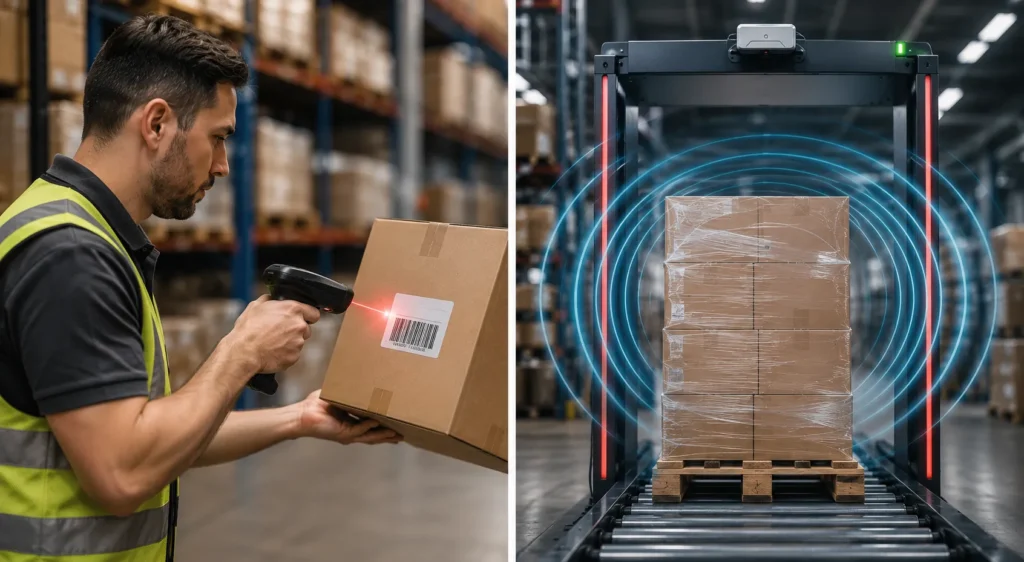
A barcode encodes data in a printed visual pattern parallel lines in the case of 1D codes like UPC and EAN, or a grid of squares in the case of 2D codes like QR and DataMatrix. A scanner reads that pattern using a laser or camera. For a scan to succeed, the reader must be aimed directly at the label, at close range, with nothing blocking the view. One scan reads one item.
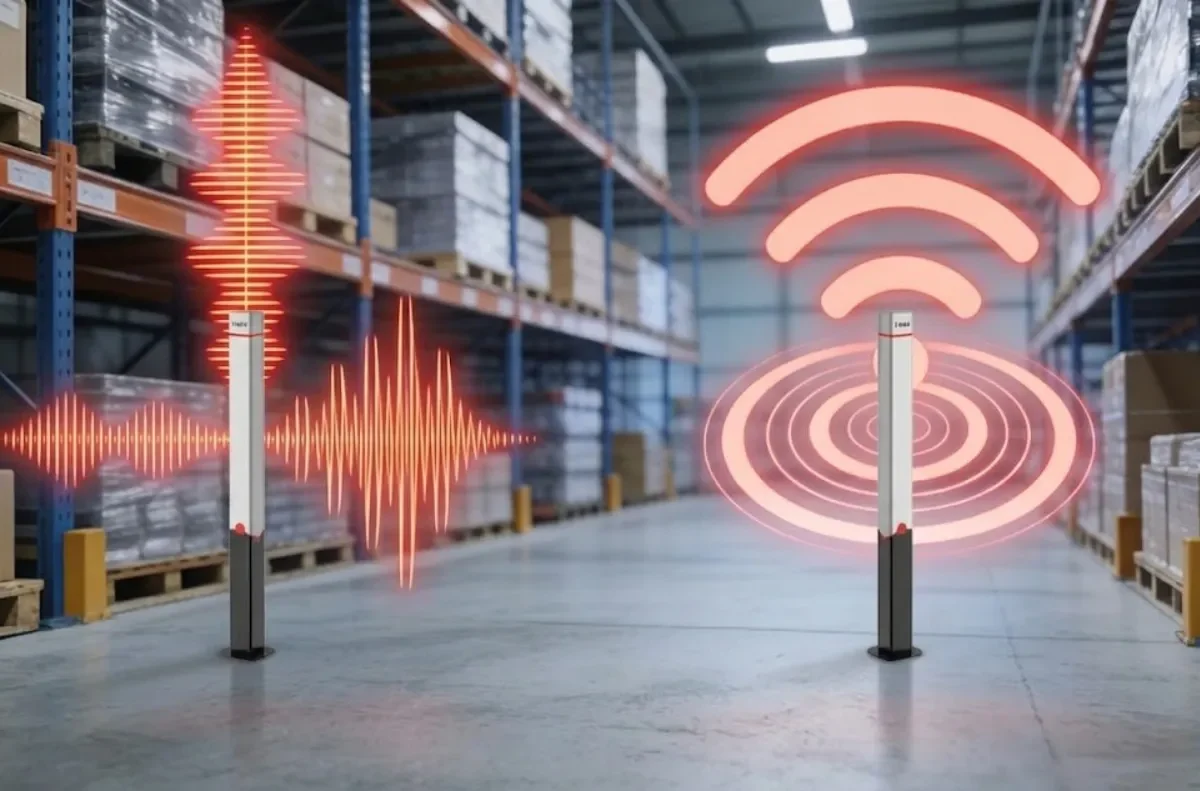
An RFID system uses radio waves. A reader broadcasts an electromagnetic signal through an antenna. Any tag within range regardless of orientation, and regardless of what is in front of it responds by transmitting its stored data back to the reader. One read event can capture hundreds of tags simultaneously, in milliseconds, through cardboard, plastic, and shrink wrap.
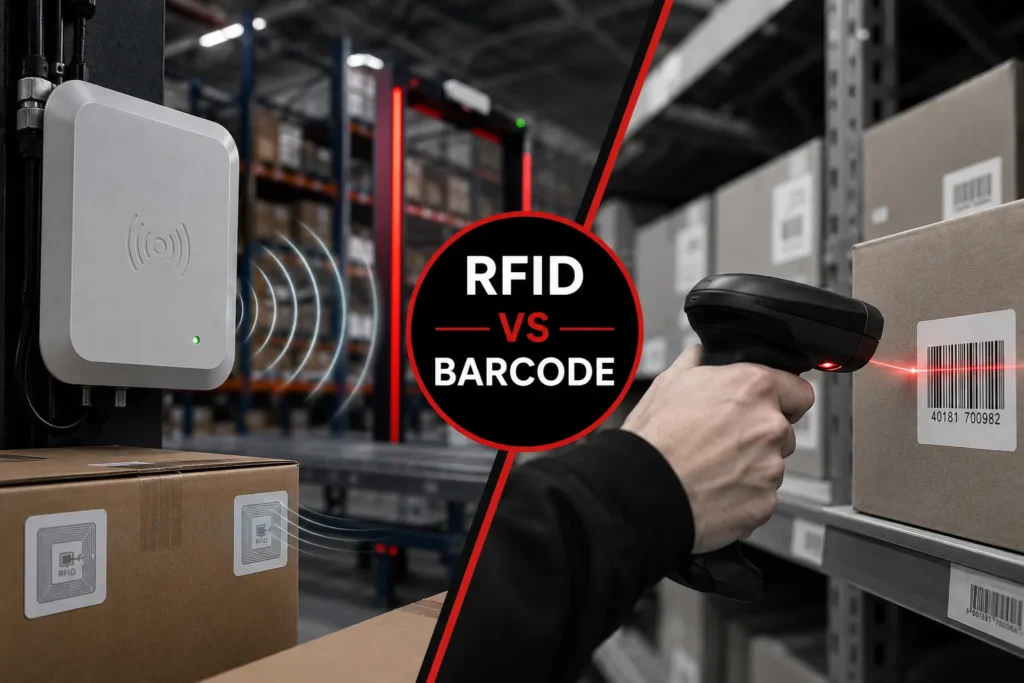
This single difference radio waves versus optics is what creates every downstream advantage and limitation you will see in the comparison below. RFID does not require human aiming or physical access to each label. Barcode does. Everything else follows from that.
For a full technical breakdown of how RFID works frequencies, tag types, antennas and the EPC Gen2 data standard see our Complete Guide to RFID Technology (2026) at https://www.ilgazi.com/blog/en/what-is-rfid/
The 10 Criteria That Actually Matter in Operations
1. Scanning Speed and Throughput
A practiced warehouse worker can manually scan approximately 12 to 20 barcode items per minute under good conditions. That number drops significantly when labels are on the bottom of boxes, inside crates, or facing away from the scanner.
A UHF RFID reader reads 200 to 700 tags per second. A worker walking a warehouse aisle with a handheld RFID reader can cover inventory that would take hours with a barcode scanner in under ten minutes. Fixed readers at dock doors capture every pallet passing through without any human involvement at all.
Verdict: RFID is not slightly faster. It is a categorically different speed class for bulk operations.
2. Inventory Accuracy
Barcode scanning accuracy is often misunderstood. The technology itself is accurate — it either reads or it does not. The problem is operational: manual scanning at scale introduces human error through fatigue, missed items, double-scans, and skipped labels. Studies consistently place real-world inventory accuracy under manual barcode scanning at around 63% in warehouse environments (CYBRA, 2026).
Well-implemented RFID removes the human scanning variable. Accuracy in optimised deployments exceeds 99.5% (SEUIC, 2025). GS1 sets 95% as the baseline benchmark for any RFID deployment worth operating. The difference between 63% and 99% accuracy is not a small operational improvement — it means the difference between a warehouse that relies on safety stock buffers and one that trusts its own data.
Verdict: RFID wins decisively, but only when the system is properly designed. A poorly installed RFID system with wrong tag selection or bad antenna placement can perform worse than a well-run barcode operation.
3. Line of Sight Requirement
This is the most fundamental constraint separating the two technologies. Barcodes require the scanner to see the label. Always. No exceptions.
In a textbook warehouse, this is manageable. In real operations, items are stacked, oriented randomly, packed in cases, or moving on conveyors. The line-of-sight requirement forces manual intervention — someone must physically reposition, flip, or unpack items to read their labels.
RFID requires no line of sight. Tags inside sealed boxes on a moving pallet read just as reliably as tags on open shelves. This is what makes automated receiving gates possible: a pallet passes through a reader portal and every item inside is logged without anyone touching the pallet.
Verdict: RFID eliminates an entire category of labour that barcode systems structurally require.
4. Simultaneous Reading
Barcode: one scan, one item. Always. RFID: one read event, hundreds of items. Always.
This difference makes RFID the only viable technology for cycle counts in high-SKU warehouses, for automated gate reads at dock doors, and for the kind of real-time inventory visibility that feeds reliable ERP and WMS data. You cannot automate a receiving dock with barcodes because every item still requires a person with a scanner. You can automate it with RFID.
Verdict: RFID is the only choice for automation at any meaningful scale.
5. Per-Unit Tag Cost
Barcode labels cost under $0.01 each, including printing. UHF RFID inlays — the passive tags used in most supply chain applications — now start at $0.04 per unit at volume. That is approximately a four times premium.
For items that cost $5 or less, this per-unit cost difference can be a real barrier. For items that cost $50 or more, the tracking value almost always justifies it.
Verdict: Barcode is cheaper per label. The question is whether per-unit cost is the right variable to optimise for your operation.
6. Infrastructure Cost
This is where the real gap lives, and where most cost comparisons mislead. The label cost is trivial compared to the infrastructure.
Barcode infrastructure is minimal: a scanner or two, a printer, basic software. A small barcode setup can be operational for under $1,000.
RFID infrastructure scales with deployment size. A single fixed reader runs $800 to $3,500. Antennas cost $100 to $400 each. Middleware and software integration add $2,000 to $50,000 or more per year depending on complexity. A single-location pilot — one dock door, one read zone — typically costs $5,000 to $15,000 including installation. A full warehouse deployment runs from $50,000 to several hundred thousand.
Verdict: Barcode wins on upfront cost, significantly. RFID infrastructure investment must be evaluated against the labour and accuracy gains it produces.
7. Data Writability and Capacity
A barcode is a printed image. Once printed, the data is fixed. An RFID tag can be read/write. A tag that leaves a warehouse labelled as in transit can be updated to received when it arrives at the destination, without removing or replacing anything physical. EPC memory on a standard UHF tag holds 96 bits by default, with user memory banks of up to 64KB available on high-capacity tags.
Verdict: RFID for rewritable, lifecycle-tracking applications. Barcode for static identification.
8. Durability in Challenging Environments
A barcode label is a piece of printed paper or film. In environments with heat, moisture, abrasion, or chemicals, it degrades. RFID tags can be fully encapsulated in plastic, ceramic, or epoxy. Industrial-grade tags survive temperatures from -40°C to over 200°C, chemical exposure, high-pressure washing, and years of outdoor UV exposure. For tool tracking, laundry management, manufacturing work-in-progress, and cold chain logistics, durability alone justifies RFID over barcode.
Verdict: RFID is the clear choice wherever labels are likely to be damaged or replaced frequently.
9. Performance on Metal and Near Liquids
This is barcode’s most genuine advantage. Optical scanning is unaffected by metal surfaces or liquid-filled products. Standard UHF RFID tags detune when mounted directly on metal, and liquids absorb radio waves, weakening signal strength.
Both are solvable. On-metal tags use a ferrite or foam substrate to isolate the antenna and work reliably on metal surfaces. LF RFID (125 kHz) penetrates liquid-heavy environments better than UHF. In October 2025, a new generation of sensor-enabled, moisture-tolerant RFID labels became available specifically for cold and wet retail environments.
Verdict: Barcode holds a real advantage here without engineering investment. ilgazi.com carries on-metal RFID tags and conducts RF site surveys to determine the right tag specification for your environment.

10. Security and Data Access Control
Barcodes are openly readable by any compatible scanner. There is no authentication, no access control, and no encryption. A barcode can be duplicated and counterfeited with minimal equipment.
RFID tags support encrypted data storage and can require authenticated readers. The TID (Tag ID) bank on every RFID chip is factory-programmed and cannot be cloned — a built-in anti-counterfeiting layer. For pharmaceutical serialisation, luxury goods authentication, and secure asset tracking, this matters significantly.
Verdict: RFID for applications where data security, anti-counterfeiting, or access control are requirements.
The Real Cost Comparison
The comparison that matters for an operations manager is not how much does a tag cost. It is: what does this system cost, and what does it save, over the next three years?
The labour math is where RFID consistently wins at scale. Consider a mid-sized distribution centre processing 3,000 to 5,000 items daily. Under a barcode system, a full physical inventory of 5,000 SKUs typically takes two staff members two full working days. Under an RFID system with fixed readers at key points and handheld readers for cycle counts, the same inventory takes under two hours. The labour saving across 12 months is substantial — and it compounds with every cycle count, every receiving event, and every discrepancy investigation that no longer requires manual re-scanning.
Add to that: inventory accuracy improvements reduce safety stock requirements. Real-time visibility reduces the time spent locating misplaced items. Automated receiving reduces inbound processing labour. Shrinkage typically drops from 2 to 3% of inventory value to under 0.5%.
Operations processing 10,000 or more items daily typically recover RFID infrastructure investment within 12 to 24 months purely through labour savings, even before accounting for accuracy gains and shrinkage reduction.
Below 5,000 daily items, the ROI case requires a more specific analysis of your particular pain points. If your primary issue is inventory accuracy, RFID often still pays. If your primary issue is simply label printing and scanning at a small scale, barcode is the right starting point.
If you would like a cost and ROI estimate for your specific operation, our team can provide one based on your volume, environment, and current system. Contact us at ilgazi.com/en/contact/ or call 0850 441 66 66.
When to Switch from Barcode to RFID
Most content on this topic gives generic advice. Here are the specific operational signals that tell you a barcode system is no longer the right tool for your volume or your environment.
Your cycle count takes more than four hours.
If completing a full inventory count requires stopping operations or scheduling a dedicated team overnight, barcode scanning is consuming labour that RFID would reclaim. A handheld RFID reader covers the same ground in a fraction of the time.
Your inventory accuracy is below 90%.
If the difference between your system records and physical reality is greater than 10%, you are making purchasing, fulfilment, and production decisions on bad data. The consequences compound: safety stock bloat, unexpected stockouts, customer service failures. Barcode systems at manual scale cannot reliably close this gap. RFID can.
You are losing assets or tools regularly.
In environments where high-value assets — surgical instruments, industrial tools, IT equipment — go missing or cannot be located quickly, RFID asset tracking typically pays for itself within months. A barcode system tells you what was scanned last. An RFID system tells you where an item is now.
You are processing more than 10,000 items per day manually.
At this volume, the labour cost of manual scanning is significant and growing. Automated RFID reading at dock doors and key choke points removes this labour cost and improves data quality simultaneously.
Your labels are being damaged and replaced frequently.
If your team spends time re-labelling items because barcode labels are torn, smudged, or unreadable, you are paying a hidden labour cost that encapsulated RFID tags would eliminate.
You have a compliance requirement.
FDA DSCSA for pharmaceuticals, EU FMD for medicinal products, and retail mandates from major chains now explicitly require RFID serialisation. In these cases, the decision is not optional.
When Barcode Is Still the Right Answer
There are genuine scenarios where barcode is the correct choice, and we will say so plainly — because we are in the business of installing the right system, not the most expensive one.
- Your volume is low and items are scanned at a fixed point. Fewer than 500 items per day at a single scan station barcode runs the operation effectively at minimal cost.
- Your items are metal and you need the lowest possible per unit cost. On metal RFID tags work well but cost more than standard inlays.
- You need consumer facing readability. A smartphone can scan a QR code without any additional hardware. For product authentication or consumer engagement, QR is often the right tool.
- You are building a pilot system with minimal initial investment. Starting with barcode to prove a tracking workflow before committing to RFID infrastructure is a reasonable approach.
How Most Serious Operations Work in 2026
The framing of RFID versus barcode implies a choice between two mutually exclusive systems. In practice, the most efficient operations in 2026 use both — each technology assigned to the workflow it handles best.
RFID typically handles:
- Automated receiving at dock doors every pallet logged without manual scanning
- Bulk cycle counts across high velocity inventory zones
- Real-time asset location in critical areas
- Tracking of items through production or processing stages
Barcode typically handles:
- Customer facing POS checkout universal compatibility with every retail register
- Compliance and shipping documentation
- Labelling of low-velocity items where RFID cost-per-tag is harder to justify
Many products in current supply chains carry both an RFID inlay and a barcode label on the same packaging the RFID for supply chain tracking, the barcode for retail checkout. This is not a compromise. It is a deliberate architecture where each technology does what it does best.
RFID Products and Solutions from ilgazi
Ilgazi is an RFID technology specialist based in İzmir, Turkey. We supply hardware from leading manufacturers, carry an extensive range of RFID tags for every application environment, and provide system design, installation, and integration services for operations across Turkey and Europe.
For operations evaluating RFID for the first time
We provide site surveys, RF environment assessments, and pilot system design. A pilot on one dock door or one storage zone is the correct starting point not a full warehouse commitment. This is how we protect your investment from day one.
For operations selecting RFID tags
Our product range covers standard UHF inlays, on-metal hard tags, laundry-grade encapsulated tags, high-temperature industrial tags, and sensor-enabled tags for cold chain applications. Not every tag works in every environment, and selecting the wrong tag type is the most common cause of underperforming RFID systems. View our RFID Tag solutions.

For operations selecting RFID readers
We carry fixed UHF readers for dock door and portal installations, handheld readers for mobile cycle counting and picking confirmation, and vehicle-mounted readers for forklift applications. View our readers.
For operations needing full system integration
We work with your existing WMS, ERP, or custom software to ensure RFID data flows where it needs to go. The hardware is only useful if the data it produces integrates cleanly into your decision-making systems. View our solutions.
Frequently Asked Questions
What is the main difference between RFID and barcode?
The fundamental difference is how data is captured. Barcodes require a direct line of sight between scanner and label, and items must be scanned individually. RFID uses radio waves no line of sight is needed, and hundreds of items can be read simultaneously without manual aiming or physical access to each label.
Is RFID more accurate than barcode scanning?
In automated deployments, yes. The accuracy problem with barcode systems is not the technology it is the human scanning process at scale. Manual scanning under real warehouse conditions yields average inventory accuracy of around 63%. RFID removes the human scanning variable and consistently delivers above 95% accuracy in well-designed systems, with optimised deployments exceeding 99.5%.
How much more expensive is RFID than barcode?
Per label or tag, UHF RFID inlays cost approximately $0.04 to $0.15 at volume, compared to under $0.01 for barcode labels. The more significant cost difference is in infrastructure: readers, antennas, middleware, and integration. A single-location pilot typically costs $5,000 to $15,000. Most operations processing 10,000 or more items daily recover the investment within 12 to 24 months through labour savings alone.
Can RFID tags be used on metal or near liquids?
Standard UHF RFID tags do not work on metal surfaces or near liquids without the right tag type. On-metal tags with ferrite or foam substrates solve the metal problem. LF RFID (125 kHz) handles liquid-heavy environments better than UHF. These are known, solvable challenges they require correct tag specification and a proper site survey. ilgazi.com stocks on-metal tags and can advise on the right specification for your application.
Can RFID and barcode work together in the same warehouse?
Yes, and this is how most advanced operations work. RFID handles automated bulk reads at dock doors and cycle counts. Barcode handles POS checkout, compliance labelling, and low-velocity items. ilgazi.com designs hybrid systems where each technology is deployed at the points where it adds the most value.
How do I know if my operation is ready for RFID?
The clearest signals your cycle count takes more than four hours, your inventory accuracy is below 90%, you are losing assets regularly, or you are processing more than 10,000 items per day manually.

İlgazi Teknoloji, an RFID company based in İzmir, develops hardware, software, and integration solutions in the fields of RFID, IoT, and smart tracking systems, providing measurable efficiency improvements to businesses in retail, logistics, warehousing, and manufacturing processes.