What Is RF Scanning?
RF Scanning
RF scanning short for Radio Frequency scanning is the process of using radio waves to automatically read the identity of a tagged object. A device called a reader broadcasts a radio signal. Any tag within range that is designed to respond to that signal will transmit its stored data back to the reader, which logs it.
The key difference from optical scanning is that radio waves do not need a clear line of sight. A reader can scan a tag inside a sealed box, on a product facing the wrong way, or on multiple items simultaneously without anyone manually aiming a device at each label. This is what makes RF scanning the foundation of modern automated inventory and asset tracking systems.
How RF Scanning Works — Step by Step
Step 1: The Reader Broadcasts
An RF reader also called an interrogator broadcasts an electromagnetic field through one or more antennas. The frequency of this field determines how the system behaves: how far it reads, how well it penetrates different materials, and how quickly it can process multiple tags.
Step 2: The Tag Responds
Any RFID tag within the reader’s field receives energy from the radio signal. In a passive tag the most common type this harvested energy powers the chip, which modulates the incoming signal to encode its stored data and reflects it back to the reader. This happens in milliseconds.
Step 3: The Reader Processes
The reader’s onboard processor captures the reflected signal, decodes the tag’s data, and applies an anti-collision protocol to handle multiple tags responding simultaneously. Modern UHF RFID readers can process hundreds of tag reads per second.
Step 4: Data Flows to Software
The decoded tag data typically an EPC that uniquely identifies the tagged item is passed through middleware to a business system: an inventory database, a WMS, an ERP, or an asset management platform. The business system then acts on the data: updating a stock count, flagging a discrepancy, generating an alert.

RF Scanning vs. Barcode Scanning
| Factor | Barcode Scanning | RF Scanning |
| How data is read | Optical — laser or camera reads a visual pattern | Radio waves — no visual access needed |
| Line of sight | Required — label must be visible and correctly oriented | Not required — reads through packaging and boxes |
| Items per scan | One at a time | Hundreds simultaneously |
| Range | 0–50cm (must be close) | 1–12m (UHF passive); 100m+ (active) |
| Human involvement | Operator must aim scanner at each label | Automated reads at fixed portals; minimal human involvement |
| Inventory accuracy | ~65% in real warehouse conditions | 95–99%+ in well-designed systems |
| Data writability | Fixed at print — cannot be updated | Read/write tags support data updates |
| Cost per label/tag | Under $0.01 | From $0.04 (passive UHF) |
RF Scanning Frequencies — Why They Matter
Different frequencies behave differently. Choosing the right frequency for a specific application is one of the most important decisions in any RF scanning system design.
| Frequency | Range | Material Penetration | Typical Use |
| LF (125–134 kHz) | Under 0.5m | Excellent — works near metal and liquids | Animal ID, vehicle immobilizers, access control |
| HF / NFC (13.56 MHz) | Under 1m | Good | Smart cards, payments, passports, library books |
| UHF (860–960 MHz) | 1–12m | Poor on metal/liquids (solvable) | Supply chain, retail, logistics, warehousing |
| Microwave (2.45 GHz) | Under 1m (high speed) | Good | Toll systems, vehicle ID, industrial automation |
UHF RFID under the GS1 EPC Gen 2 / RAIN RFID standard is the dominant frequency for commercial RF scanning applications. It offers the best balance of read range, read speed, and tag cost for supply chain and inventory management use cases.
Where RF Scanning Is Used
Retail and Apparel
Item-level RFID enables store inventory counts in minutes rather than hours, reduces out-of-stock events by up to 50%, and enables store-as-warehouse fulfilment for online orders. Zara, H&M, Walmart, and most major global apparel retailers use RF scanning at the item level.
Warehousing and Logistics
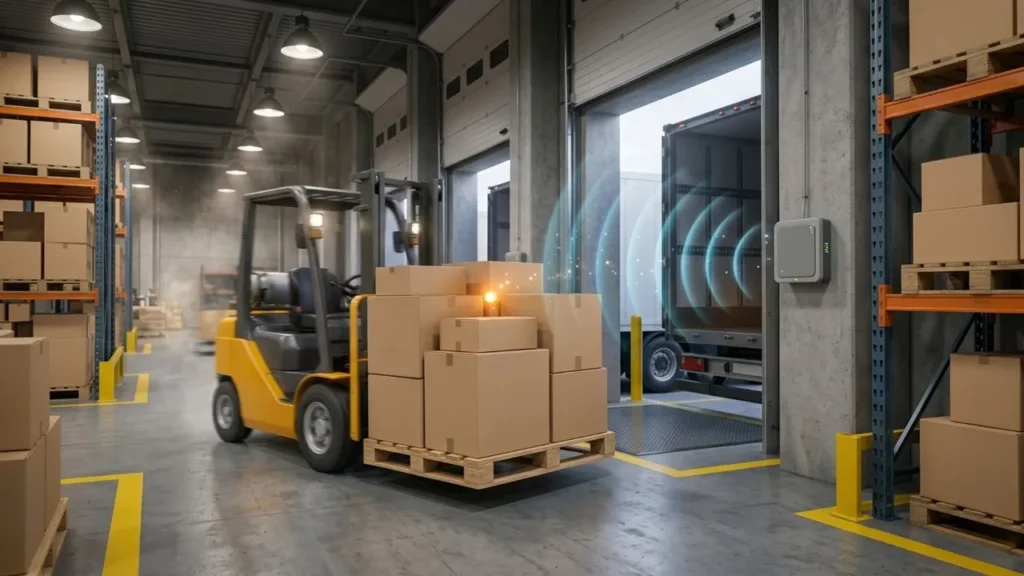
Fixed RF readers at dock doors automatically log every pallet entering or leaving a facility. Forklift mounted readers create continuous inventory snapshots during normal operations. Handheld readers enable rapid cycle counts without operational shutdowns.
Healthcare
RF scanning tracks medical equipment location, surgical instrument sterilization compliance, patient identification, and pharmaceutical serialization. The healthcare RFID market is growing at 17.1% annually through 2032.
Manufacturing
Work-in-progress components are scanned automatically at each production stage. Assembly confirmation, quality gate verification, and finished goods dispatch all generate automatic RF scan records without manual operator input.
Access Control and Security
HF RFID cards and fobs authenticate personnel at secure entry points. LF RFID transponders in vehicles are read at gate entry systems. RFID key cabinets use RF scanning to authenticate users and log key movements.
Libraries
Books carry HF RFID labels that enable automated checkout, overnight inventory counts, and EAS security at exits — replacing manual barcode scanning and electromagnetic security strips.
Common Misunderstandings About RF Scanning
‘RF scanning is always more expensive than barcode’
This is true at the per-unit tag level. It is typically false at the total cost of ownership level for operations above a certain volume threshold. Labour savings from automation and accuracy improvements from eliminating manual scanning errors make RF scanning the lower-cost option over a 2 to 3 year horizon for most mid-to-large operations.
‘RF scanning can read any tag anywhere’
RF scanning is subject to real physical constraints. Metal surfaces reflect radio waves and detune tag antennas. Liquids absorb UHF frequencies. Dense tag clusters can overwhelm anti collision protocols if not properly managed. These are solvable engineering challenges not fundamental limitations but they require correct system design.
‘RF scanning requires replacing all existing barcodes’
Most RFID deployments supplement, not replace, existing barcode infrastructure. RF scanning handles automated bulk reads at key points; barcodes remain on packaging for human-readable identification, POS scanning, and supply chain partners who have not adopted RFID. Dual-carrier labels carrying both an RFID inlay and a barcode are standard practice in most supply chains.
Frequently Asked Questions
Is RF scanning the same as RFID?
Yes. RF scanning and RFID refer to the same underlying technology and are used interchangeably in most operational contexts. RF scanning describes the action reading a tag using radio frequencies. RFID describes the technology system the combination of tags, readers, antennas, and software that enables RF scanning.
Can a smartphone perform RF scanning?
Consumer smartphones can perform NFC scanning a short-range form of HF RFID at 13.56 MHz which is used for contactless payments, tag verification, and consumer-facing product authentication. Standard UHF RFID requires dedicated UHF RFID hardware. Smartphone based UHF reading requires an external accessory reader.
How fast is RF scanning compared to barcode scanning?
A practiced operator can manually barcode-scan 12 to 20 items per minute under good conditions. A UHF RFID reader processes 200 to 700 tag reads per second. In practical terms, an RF scan of a warehouse aisle that holds 500 items takes seconds with a handheld RFID reader. The same count with a barcode scanner would take 30 to 40 minutes with manual aiming and scanning of each item.
What data is stored on an RFID tag in an RF scanning system?
The minimum data stored on a standard UHF RFID tag is an EPC a globally unique identifier that typically encodes company prefix, product category, and serial number. This identifier links to the item’s full record in the connected business system. Tags can also store additional data in user memory banks: maintenance records, process step completion, custody chain entries, and sensor readings on sensor-enabled tags.
Does RF scanning work outdoors?
Yes. UHF RFID readers and antennas rated for outdoor installation IP65 or IP67 weather resistant ratings are used for yard management, gate entry systems, vehicle tracking, and outdoor asset management. Outdoor installations require weatherproof antenna and reader housings, and antenna positioning that accounts for environmental interference sources not present indoors.

İlgazi Teknoloji, an RFID company based in İzmir, develops hardware, software, and integration solutions in the fields of RFID, IoT, and smart tracking systems, providing measurable efficiency improvements to businesses in retail, logistics, warehousing, and manufacturing processes.
