What Is RFID Antenna and Tag Antenna Polarization? How Does It Affect Read Performance?
In any RFID system, the reader software, hardware, and tag chip are largely mature and standardized components. So why do some deployments work flawlessly while others battle constant read errors? The answer almost always lies in the same place: antenna polarization and tag placement
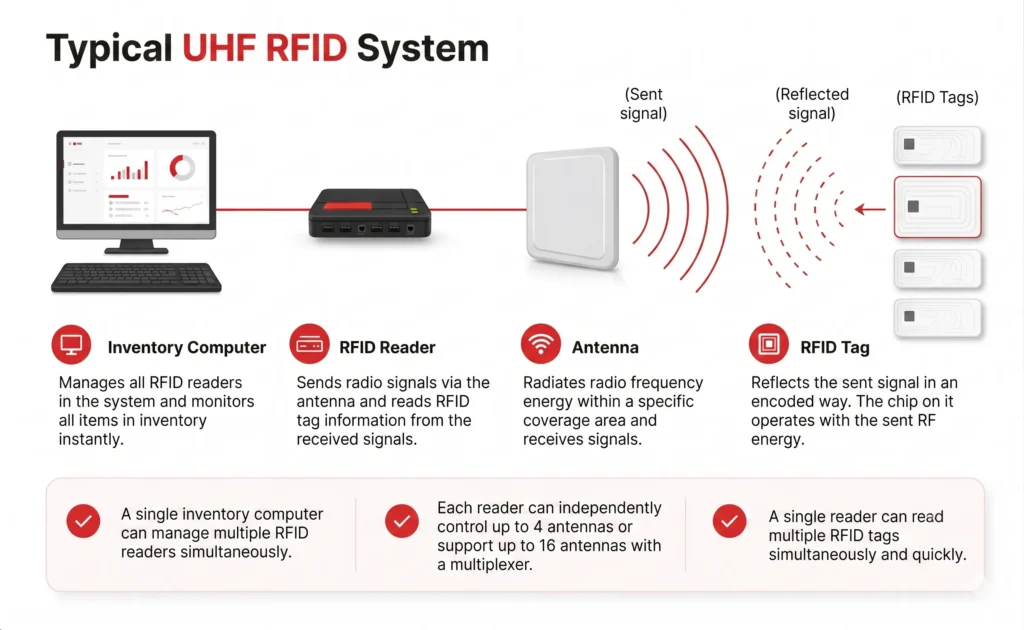
What Is Polarization
An antenna radiates electromagnetic waves. The direction of the electric field component of those waves in space defines the antenna’s polarization. In plain terms it answers the question “in which direction is the signal oscillating?”
In UHF RFID systems (860–960 MHz), polarization directly determines how effectively the signal from the reader antenna is transferred to the tag and therefore whether the tag can be read at all.
“Polarization defines the predominant direction of the electric field radiated or received by an antenna. The polarization of the receiving antenna (RFID tag) needs to be at least partially aligned with the polarization of the transmitting antenna.” — RJ Burkholder, Research Professor of Electromagnetics and RF, The Ohio State University
If this alignment is absent or reversed the tag may not be read at all. This condition is called “polarization loss” or, in technical terms, “polarization mismatch.”
Linear Polarization
How Linear Polarization Works
A linearly polarized antenna radiates its electric field oscillating in a single plane either vertical or horizontal. The classic patch antenna falls into this category.
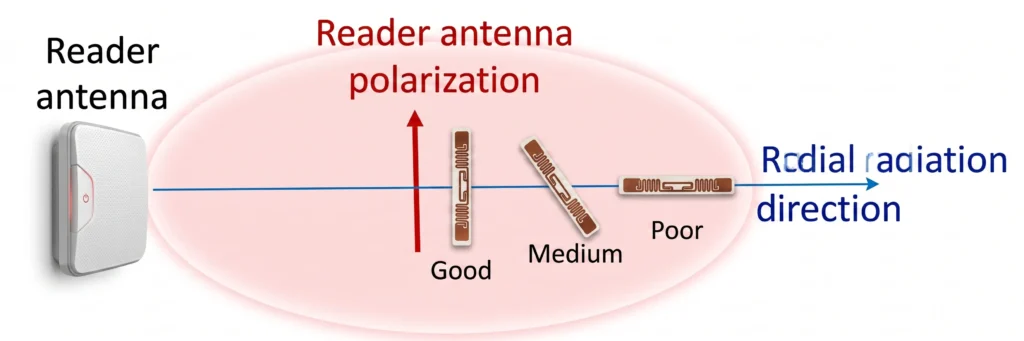
An RFID tag antenna is also a linearly polarized dipole. When this dipole is aligned with the reader’s electric field direction, it receives maximum energy and delivers the strongest read signal.
Linear polarization’s greatest weakness is its sensitivity to tag orientation. The table below illustrates this relationship clearly:
| Tag Orientation (Relative to Reader) | Signal Reception | Read Probability |
| Aligned with reader field (0°) | Maximum | Very high |
| Rotated 45° | Partial (–3 dB) | Moderate |
| Perpendicular (90° — fully rotated) | Zero | Unreadable |
| Radial direction (facing the antenna) | Zero | Unreadable |
In real-world deployments, products never stay in a fixed orientation. Boxes on conveyors, garments on hangers, items in shopping carts all can be positioned at unpredictable angles. In these environments, linear polarization inevitably creates read gaps.
Circular Polarization – The UHF RFID Standard
What Is Circular Polarization?
Circular polarization (CP) combines vertical and horizontal polarization components with a 90° phase difference between them. The resulting electric field rotates in a spiral as it propagates away from the antenna.
This rotating field structure means a CP antenna can read a tag oriented in virtually any plane transverse to the direction of radiation regardless of whether the tag faces vertically or horizontally.
Why Is It the Industry’s Preferred Choice?
Because CP antennas are tolerant of tag orientation, they are preferred in any application where tag direction cannot be controlled. Retail stores, warehouse dock doors, conveyor tunnels, and library shelves are leading examples.
| Feature | Linear Polarization | Circular Polarization (CP) |
| Tag orientation tolerance | Low | High |
| Maximum read range | Longer (with LP tag) | Shorter (–3 dB) |
| Reads misaligned tags | No | Yes |
| Most common use case | Fixed, single-direction items | Dynamic, multi-orientation environments |
| Prevalence in UHF RFID | Specialized applications | Standard choice |
The 3 dB Loss: What Does It Mean in Practice?
The orientation tolerance of CP antennas comes at a cost: a theoretical 3 dB gain reduction when reading linearly polarized tags. How significant is this?
CP Tag + CP Antenna: A Combination to Watch Carefully
Using a CP tag with a CP reader antenna is not always the optimal choice. Circular polarization has a left hand or right hand definition (LHCP / RHCP). If the CP tag is not correctly matched or oriented relative to the CP reader antenna, it may not be detected at all.
For this reason, the most reliable and predictable combination in the vast majority of applications remains: CP reader antenna + linearly polarized tag.
Antenna Diversity and Polarization Diversity
Why a Single Antenna Is Often Not Enough
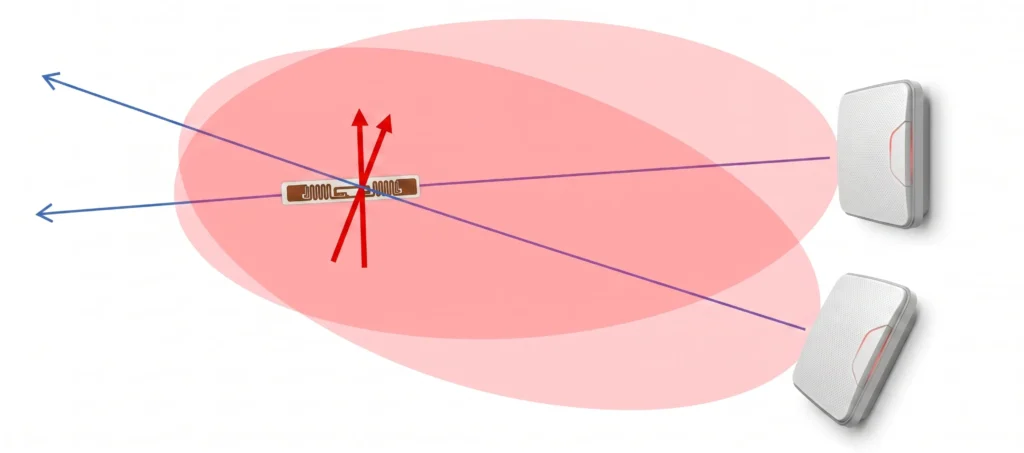
In real-world deployments, a single antenna is frequently insufficient to read all tags with 100% reliability. This is particularly true at warehouse dock doors and retail store exits, where tags arrive in unpredictable orientations and a single antenna creates critical read gaps.
Antenna Diversity
UHF RFID readers typically offer multiple antenna ports. The reader cycles through these ports sequentially, reading from different angles. If one antenna misses a particular tag, another is likely aligned with it. This approach is especially critical in tunnel and portal systems.
Polarization Diversity
Multiple antennas can read not only from different locations but also from different polarization angles. When vertically and horizontally polarized antennas are used together, any tag — regardless of orientation — is captured by at least one of them.
| Diversity Type | How It Works | When to Use |
| Spatial Diversity | Antennas placed at different physical locations | Large warehouses, wide dock doors |
| Polarization Diversity | Antennas with different polarization orientations | Random-orientation tags, tunnel readers |
| CP Antenna | Single antenna reads in all orientations | Medium-volume areas, transition points |
Tag Surface Compatibility: Metal, Liquids, and Thick Materials
Beyond polarization, the surface to which a tag is attached directly affects read performance. Standard RFID tags either fail completely or suffer dramatic performance degradation under certain surface conditions.
Metal Surfaces
A standard printed RFID tag placed directly on a metal surface is effectively shorted out — the tag becomes unreadable in practice. Metal reflects RF signals and shifts the tag antenna’s resonant frequency away from its operating range.

Liquid-Filled Products
Water and liquids absorb UHF RF signals significantly, attenuating them before they reach the tag. Standard tags placed in direct contact with liquids or on the surface of liquid-filled containers experience severe performance degradation.
- Avoid placing standard tags directly on liquid surfaces
- Liquid-tolerant tags (wet inlays) or on-metal tags deliver more reliable results in these environments
- A foam spacer between the tag and the liquid container also improves performance
Plastic, Rubber, Wood, and Concrete
Thick dielectric materials detune the tag antenna — shifting its resonant frequency — and reduce read range. RF waves are also attenuated as they pass through these materials, compounding the performance loss.
- Use tags specifically designed and tuned for the target material
- Significant performance degradation should be expected with standard tags; thorough testing is essential
Paper, Cardboard, Fabric, Thin Plastic, and Glass
These are the ideal surfaces for standard RFID tags, delivering maximum read performance. Tags can be concealed inside packaging, laminated within a label, or embedded inside a thin plastic card — all with excellent read rates.
One important note for textile applications: the tag should never be in direct contact with skin. An inner lining or an additional layer of fabric should always be present as a buffer.
Sector-Specific Deployment Recommendations
Retail: EAS and Inventory Counting
In apparel stores, products hang, fold, or stack in constantly varying orientations. CP antennas are the default choice, and tag placement on each item should be optimized for the product’s geometry. Signal consistency between the i-POS reader at the checkout and the i-EAS antenna at the exit gate is directly dependent on correct tag placement.
Our Solutions:
- I-EAS V35NL Series RFID Security Systems
- I-POS RAIN RFID Checkout Reader
- I-Hand C72 RFID Store Inventory Device
Warehousing and Logistics – Tunnel and Portal Systems
Cartons arriving on conveyors can come from any angle. In tunnel systems, multiple antennas are mounted on different surfaces to provide both spatial and polarization diversity. Tag placement on the carton is equally critical: on metal-containing boxes, a spacer must be used, and tags should be placed on non-metallic faces.
Our Solutions:
Textile Manufacturing: Fabric and Roll Tracking
Fabric and textile products represent an ideal RFID environment — thin, non-conductive material maximizes signal transparency. However, when items are stacked with all tags concentrated at the same point, mutual interference can cause read failures. Distributing tag placement randomly across the item surface resolves this in most cases.
Our Solutions:
Frequently Asked Questions (FAQ)
What is RFID antenna polarization?
Polarization defines the direction of the electric field in the electromagnetic wave radiated by an antenna. In UHF RFID systems, this direction determines how effectively the reader’s signal is transferred to the tag. The better the polarization alignment between the reader antenna and the tag antenna, the higher the read performance.
What is the difference between linear and circular polarization in RFID?
A linearly polarized antenna radiates its signal in a single direction (vertical or horizontal) and may miss tags that are not aligned with that direction. A circularly polarized (CP) antenna radiates a rotating field and can read tags in virtually any orientation transverse to the direction of propagation. The trade off is a theoretical 3 dB (approximately 30% range) gain reduction when reading linear tags.
Can polarization mismatch be the cause of RFID read errors?
Can polarization mismatch be the cause of RFID read errors?
Yes, polarization mismatch is one of the most common and most overlooked causes of read failures. If tags are not consistently oriented and a single linear antenna is used, certain tags will not be read at all. The solution is to use a CP antenna or to implement antenna diversity.
Can RFID tags be placed on metal surfaces?
Standard printed tags cannot be placed directly on metal the antenna shorts out and the tag becomes unreadable. Two solutions exist: (1) use a purpose-built on-metal tag with an integrated spacer, or (2) place a standard tag on top of at least 3 mm (1/8″) of foam spacer. The second approach is cost-effective and works well in most cases.
Should a circular polarization antenna always be preferred in RFID?
Not necessarily. In applications where tags are always fixed in the same orientation, a linearly polarized antenna delivers longer read range and stronger signal. CP is the right choice when tag orientation cannot be controlled.
What is antenna diversity and why does it matter?
Antenna diversity is the technique of using multiple antennas cycled sequentially by the reader to cover different positions and angles within a read zone. If one antenna misses a particular tag, another is likely aligned with it. In tunnel and portal systems, antenna diversity is not optional; it is a baseline requirement for reliable operation.

İlgazi Teknoloji, an RFID company based in İzmir, develops hardware, software, and integration solutions in the fields of RFID, IoT, and smart tracking systems, providing measurable efficiency improvements to businesses in retail, logistics, warehousing, and manufacturing processes.